
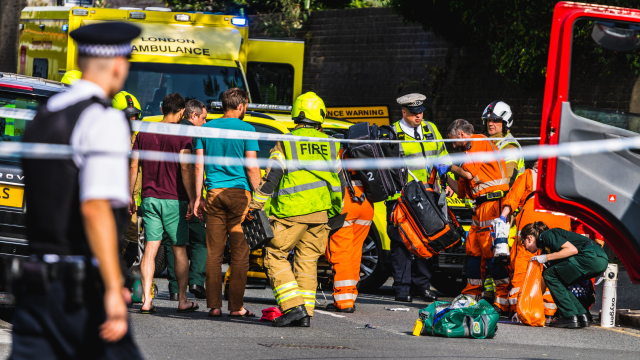
Driving an emergency vehicle is one of the clearest examples of a job where speed and safety can appear to pull in opposite directions.
An ambulance may be responding to cardiac arrest. A fire appliance may be travelling to a serious building fire. A police response vehicle may need to reach an incident where somebody is in immediate danger. Every unnecessary delay matters, but so does every decision made on the journey.
That is why Emergency Vehicle Operations Training is much more demanding than learning how to drive quickly.
Professional emergency drivers need observation, anticipation, vehicle-control skills, knowledge of the law and the ability to make calm decisions under pressure. They must understand when emergency-driving exemptions apply, how other road users are likely to react and when reducing speed is safer than using the theoretical performance available from the vehicle.
For somebody exploring Emergency Vehicle Operations UK, it is also important to understand that there is no single short course or universal “blue-light licence” covering every role. Police, ambulance, fire and other authorised services use role-specific training, assessments and internal authorisation arrangements.
Good emergency driving is therefore not defined by how quickly somebody reaches the destination. It is defined by getting there with urgency while controlling risk throughout the journey.
What Is Emergency Vehicle Operations Training?
Emergency Vehicle Operations Training develops the knowledge and practical skills needed to operate vehicles safely in urgent and emergency situations.
The exact course depends on the service and role.
An ambulance driver may undertake a regulated emergency-response ambulance-driving qualification. Police drivers train through the Police Driving Curriculum and are authorised at different driving levels. Fire and rescue services have their own operational driver-training arrangements.
Although the programmes differ, several core themes recur:
- systematic observation;
- vehicle control;
- anticipation of hazards;
- safe use of speed;
- positioning;
- braking and cornering;
- emergency warning equipment;
- legal exemptions;
- decision-making; and
- risk management.
The most important element is judgement.
A technically skilled driver who cannot recognise when speed has become inappropriate is not a safe emergency driver.
Emergency driving is not ordinary advanced driving
Advanced road-driving techniques provide a valuable foundation, but Emergency Vehicle Safety response introduces additional complexity.
Other road users behave differently when they see flashing blue lights or hear sirens.
Some pull over immediately. Others stop in unsafe places. A driver may enter a bus lane unnecessarily, brake suddenly or freeze in the middle of a junction.
The Emergency Vehicle Safety driver has to anticipate those reactions.
At the same time, the vehicle itself may be heavier, longer or dynamically different from an ordinary car.
An ambulance may also contain a patient receiving treatment and clinicians who need a stable working environment.
This turns every decision about acceleration, braking and cornering into both a driving and operational judgement.
Why Is Emergency Vehicle Safety Important?
Why is emergency vehicle safety important? Because emergency services exist to reduce harm, and a collision during the response can create additional casualties instead.
Urgency does not remove physics.
A vehicle travelling faster requires more distance to stop. Cornering forces increase. The time available to recognise and react to hazards decreases.
Emergency Vehicle Safety warning equipment can alert other road users, but it does not guarantee they have seen or heard the approaching vehicle.
A driver therefore needs to operate on the assumption that somebody may respond unpredictably.
The wider road-safety context
Great Britain still recorded 1,538 road deaths and nearly 30,000 killed or seriously injured casualties in 2025.
Emergency Vehicle Safety vehicles operate inside the same road environment.
Pedestrians may step into the carriageway. Motorcyclists can be hidden from view. Drivers may emerge from side roads. Wet surfaces reduce available grip.
The difference is that the Emergency Vehicle Safety driver may also be managing time pressure, radio communication, navigation and the emotional knowledge that somebody needs urgent help.
Effective Emergency Vehicle Safety training is designed to prevent those pressures from overwhelming normal risk awareness.
A collision can affect the original emergency too
An emergency-vehicle collision has consequences beyond the people directly involved.
The crew may no longer reach the incident.
Another unit may need to be dispatched.
A patient already inside an ambulance may be placed at further risk.
Roads may need to close while the collision is investigated.
Safe driving therefore supports emergency response rather than competing with it.
The Legal Framework for Emergency Driving
One of the most common misconceptions is that blue lights give emergency drivers permission to ignore road law.
They do not.
Certain statutory exemptions exist for specified Emergency Vehicle Safety purposes and properly qualified or authorised drivers, but the exemptions are limited.
Current College of Policing guidance, for example, identifies exemptions that can allow authorised police drivers in appropriate circumstances to depart from requirements relating to speed limits, keep-left or keep-right signs and traffic signals.
These exemptions exist so emergency services can perform urgent duties where following the ordinary restriction would hinder the purpose for which the vehicle is being used.
They do not turn every traffic rule into an option.
Exemption does not mean unlimited discretion
An Emergency Vehicle Safety driver remains accountable for how the vehicle is driven.
Driving at a speed that cannot be justified by the conditions can still create serious legal and professional consequences.
The fundamental question remains whether the decision was safe and proportionate in the circumstances.
A legal ability to proceed through a red signal, for example, does not make it safe to enter a junction without ensuring that other road users can react appropriately.
Emergency-driving instruction therefore concentrates heavily on judgement rather than simply teaching a list of exemptions.
What Do Blue Lights and Sirens Actually Do?
Warning equipment communicates urgency.
Blue lights, sirens and, where authorised, flashing headlights are intended to make road users aware that an emergency vehicle is approaching.
They do not physically create right of way.
This distinction is crucial.
A driver responding under emergency conditions cannot assume that every vehicle ahead will disappear immediately.
The Highway Code tells other motorists to consider the route of an approaching emergency vehicle and make appropriate space without putting themselves or others in danger.
It also tells them to continue obeying traffic signs.
That means an Emergency Vehicle Safety driver should not expect somebody to cross a red light, mount a pavement or enter an unsafe location merely to provide space.
Good Emergency Response Driving creates opportunities for other road users to respond safely rather than pressuring them into dangerous manoeuvres.
Observation and Anticipation
Observation is arguably the most important emergency-driving skill.
The driver needs to process what is happening now while predicting what may happen several seconds later.
Consider approaching a row of parked cars.
A beginner may see only stationary vehicles.
An experienced emergency driver may notice:
- a delivery driver’s door beginning to move;
- a child’s feet beneath a parked vehicle;
- brake lights ahead;
- a side road partly obscured by a van; and
- a pedestrian looking towards the opposite direction.
None of those observations proves that a hazard will develop.
They create possibilities.
The driver then adjusts position and speed so that, if something changes, there is still time and space to respond.
This is anticipation.
Vision should extend beyond the vehicle in front
Following the nearest vehicle closely narrows the driver’s information.
Looking further ahead allows earlier recognition of congestion, traffic signals and developing hazards.
Mirrors matter equally.
An emergency driver needs to understand what is happening behind and beside the vehicle, particularly before changing position or speed.
Continuous observation builds a mental picture of the road environment.
That picture allows smoother and safer decisions.
Vehicle Control During Emergency Response
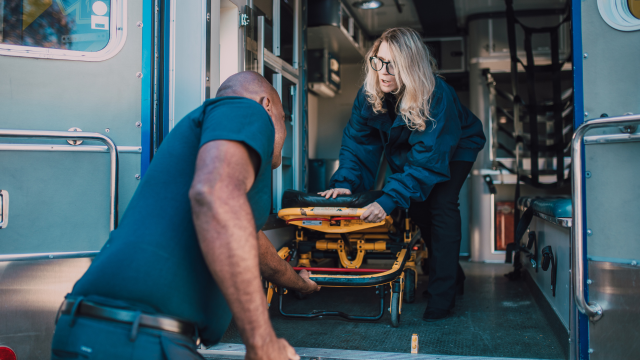
A professional Emergency Vehicle Driver needs to understand what the vehicle will do before asking it to do it.
Ambulances, police cars, fire appliances and specialist response vehicles can have very different characteristics.
Vehicle mass is particularly important.
A large fire appliance will not accelerate, steer or stop like a small response car.
Its height and width also affect clearance and stability.
Braking
Emergency Vehicle Safety driving is not about braking as late as possible.
Good drivers recognise hazards early enough to brake progressively.
Smooth braking keeps the vehicle stable and gives following traffic more opportunity to react.
It can be especially important in ambulances, where sudden movements may affect patients and clinical staff.
Steering
Steering inputs should be planned and controlled.
Entering a corner too quickly and attempting to solve the problem with additional steering is poor technique.
The driver should assess the corner before entering it, choose an appropriate speed and maintain a stable line.
Acceleration
Acceleration should also be purposeful.
Using maximum acceleration whenever the road opens briefly may create repeated acceleration-braking cycles without producing meaningful progress.
Smoothness and planning often make a journey both safer and more efficient.
The System of Car Control
Emergency-service driver training commonly draws on the systematic approach associated with advanced driving and Roadcraft.
The objective is to deal with hazards in a consistent sequence instead of reacting at the final moment.
A driver identifies a hazard early, gathers information, adjusts position and speed appropriately and selects the correct response before accelerating away when it is safe.
The terminology used in individual training programmes may vary, but the underlying idea is powerful.
Driving should be planned.
A bend, junction, pedestrian crossing or stationary vehicle should not arrive as a surprise.
The system creates mental discipline at precisely the time when urgency might otherwise encourage impulsive decisions.
Emergency Response at Junctions
Junctions are among the highest-risk parts of emergency driving because several streams of traffic can conflict within a small space.
A green light is not a guarantee that the junction is clear.
A red-light exemption does not mean the driver can enter without caution.
An emergency vehicle approaching against a red signal needs to consider whether drivers in other directions have seen it, whether pedestrians are crossing and whether buildings or other vehicles obstruct visibility.
Speed may need to reduce substantially.
Sometimes the safest response is almost to stop.
This is not wasted time.
A serious collision would delay the response far more.
Overtaking During Emergency Driving
Overtaking needs space, visibility and a safe opportunity to return to the correct side of the road.
Emergency warning equipment does not change these fundamentals.
A slow vehicle ahead may know that an ambulance is approaching but be unable to pull over immediately.
The emergency driver needs to read the road ahead rather than force an overtake because the vehicle in front has not responded quickly enough.
Blind bends, crests and narrowing roads require particular caution.
The professional question is not simply:
“Can I get past?”
It is:
“Can I complete the entire manoeuvre safely if something appears that I cannot currently see?”
Motorways and High-Speed Roads
Higher-speed environments create different risks.
Traffic may already be travelling close to the national speed limit. Closing speeds can therefore become substantial.
Drivers need to monitor lanes well ahead, identify congestion early and avoid sudden changes that other motorists cannot understand.
Motorway incidents can also involve blocked lanes, red X signals, emergency corridors and stationary traffic.
Special statutory exemptions may exist for authorised emergency drivers in defined circumstances, but professional training remains essential because misuse can place road workers, stranded motorists and emergency personnel at considerable risk.
High speed leaves less margin for correcting mistakes.
That makes observation even more important, not less.
Driving in Poor Weather and Darkness
Rain, ice, fog and darkness change the amount of risk that can safely be accepted.
The fact that an incident is urgent does not restore tyre grip.
Wet surfaces increase stopping distances. Standing water can destabilise vehicles. Fog restricts how far ahead the driver can reliably assess the road.
At night, lights can create additional visual problems.
Blue warning lights may reflect from signs, windows and wet surfaces, while headlights reveal only part of the environment.
Emergency drivers therefore need to reduce speed according to the actual conditions rather than the urgency written on the incident log.
A useful principle is simple: never drive beyond the distance in which you can reasonably respond to what becomes visible.
Managing Stress and Human Factors

Emergency driving is a human-performance problem as much as a technical driving problem.
Sirens, radios, urgency and uncertainty increase mental workload.
A driver may know that a child is seriously ill or that colleagues are requesting urgent assistance.
That information can unconsciously change behaviour.
Drivers may accelerate harder, accept smaller gaps or begin focusing excessively on reaching the destination.
Training needs to build awareness of these effects.
Tunnel vision
Stress can narrow attention.
The driver becomes focused on the road directly ahead and stops processing peripheral information.
That creates obvious risks at junctions and pedestrian environments.
Deliberately maintaining a broad visual scan helps counter this effect.
Overconfidence
Experience can also create risk.
A driver who has completed hundreds of responses successfully may begin to interpret the absence of previous collisions as evidence that increasingly aggressive behaviour is safe.
Professional standards therefore require continuous self-assessment and refresher development.
Experience should improve judgement, not reduce caution.
Ambulance Emergency Response Driving
Ambulance driving illustrates particularly well why formal training matters.
Current regulated provision includes the Level 3 Certificate in Emergency Response Ambulance Driving (RQF), commonly known as CERAD.
The qualification covers preparing, driving and manoeuvring ambulance vehicles during routine and emergency-response conditions.
Its current structure includes 120 guided learning hours and 150 hours of total qualification time.
Training resources used by NHS ambulance services include subjects such as legislation, emergency-driving exemptions, motorway and carriageway procedures, braking and steering, systematic vehicle control, cornering, overtaking, manoeuvring, vehicle safety and human factors.
This is far more substantial than a general defensive-driving course.
Driving entitlement also matters
Emergency-response qualifications do not replace the underlying driving licence required for the vehicle.
Many frontline ambulance roles involve vehicles for which a C1 entitlement is required, and current NHS recruitment examples may specify both the relevant licence category and CERAD or an accepted equivalent.
Applicants need to check the individual ambulance service because recruitment requirements can vary.
Police Emergency Driving
The College of Policing currently distinguishes three police-driver levels: basic, response and advanced.
A basic police driver must hold the appropriate full driving licence but does not have authority simply to use emergency ancillary equipment to facilitate progress.
A response driver must be trained and authorised to the prescribed Police Driving Curriculum standard for response driving.
Advanced drivers receive further specialist training for advanced-performance vehicles and duties.
The distinction demonstrates a wider principle within Emergency Vehicle Operations UK.
Simply working for an emergency service does not automatically give somebody the same driving authority as every other employee.
The individual driver’s training level, authorisation, vehicle and operational purpose matter.
Fire and Rescue Driving
Fire appliances create their own driving challenges.
They may be considerably larger and heavier than cars or ambulances and can carry crews, water and equipment.
Their dimensions affect turning, clearance and stopping distances.
Drivers also need to deliver crews safely enough that they can begin operational work immediately after arrival.
Training therefore needs to combine road-driving ability with understanding of the particular appliance.
A person who is confident driving a private car is not automatically competent to operate a large emergency appliance under response conditions.
Employer training, vehicle-category entitlement, assessment and service authorisation remain central.
Road Safety Training vs Emergency Response Training
General Road Safety Training can improve hazard perception, defensive driving and awareness.
That makes it useful.
It should not be confused with specialist emergency-response qualification.
A general course might teach:
- observation;
- stopping distances;
- fatigue awareness;
- distraction prevention; and
- defensive driving.
Emergency-response training adds a much more demanding operational layer.
The learner may need to understand statutory exemptions, warning equipment, high-speed decision-making, vehicle-specific handling and service procedures while being assessed practically.
This distinction is important when comparing courses online.
A certificate carrying words such as “emergency vehicle”, “blue-light” or “response driver” does not automatically establish that the programme is recognised by an emergency-service employer or legally sufficient for exercising particular exemptions.
What Makes a Good Emergency Vehicle Driver?
Technical ability matters, but the best drivers are rarely those most eager to demonstrate it.
A strong Emergency Vehicle Driver tends to be predictable, observant and disciplined.
They plan early.
They recognise when another road user has not noticed them.
They are willing to slow down even when the call is urgent.
They communicate clearly with their crew.
Most importantly, they understand that professional emergency driving is about managing risk rather than displaying confidence.
Essential skills include
A professional driver needs strong observation and anticipation, accurate vehicle positioning, controlled braking and acceleration, legal knowledge and the ability to make proportionate decisions.
Communication and emotional self-control matter as much as physical coordination.
The driver must also remain receptive to assessment and feedback.
Emergency-driving competence is maintained, not permanently acquired on the day a certificate is issued.
Training, Assessment and Refresher Development
Professional Emergency Vehicle Operations Training should include more than classroom theory.
Driving is a practical skill.
Learners need supervised experience in relevant vehicles and conditions, supported by meaningful assessment.
Knowledge of road law may be tested separately from practical competence.
The precise assessment system differs between services and qualifications.
Refresher training is also important.
Road law changes. Vehicles change. Technology changes. More importantly, driving habits can change over time.
Some NHS ambulance-service driving educator roles, for example, explicitly include emergency-response driving refresher sessions, post-collision support and quality-assurance work.
That reflects a wider principle: organisations should monitor driving standards continuously rather than assuming initial qualification is enough forever.
Emergency Vehicle Safety and the Public
Emergency driving depends partly on cooperation from ordinary road users.
The safest response when an emergency vehicle approaches is not to panic.
Highway Code Rule 219 tells motorists to consider its route, make appropriate space and continue complying with traffic signs.
Drivers should not mount the kerb or brake dangerously simply because they hear a siren.
If appropriate, they can move to the side and stop somewhere safe.
The emergency driver is trained to find a route through traffic.
Other motorists help most by remaining predictable.
This shared understanding is an important part of Emergency Vehicle Safety because collisions can occur when people make sudden decisions while attempting to be helpful.
Career Routes in Emergency Vehicle Operations
There is no standalone career called emergency vehicle driving that follows one national route.
Instead, driving normally forms part of a wider occupation.
Ambulance staff may combine response driving with patient-care responsibilities.
Police drivers are police officers or other authorised personnel performing policing functions.
Fire appliance drivers operate within fire and rescue roles.
Other authorised organisations can have their own specialist arrangements.
This means somebody interested in emergency driving should begin by identifying the service and occupation they actually want.
Then check:
- the required ordinary driving licence;
- occupational entry requirements;
- employer-provided or recognised emergency-driving training;
- vehicle-category requirements; and
- ongoing assessment or authorisation.
Do not choose a private course first and assume employers will accept it afterwards.
Start with the target role.
The Future of Emergency Vehicle Operations UK
Technology will change emergency driving, but it is unlikely to eliminate the need for human judgement quickly.
Vehicles increasingly include collision-warning systems, automatic emergency braking, stability control and advanced navigation.
Ambulance and emergency fleets are also beginning the longer transition towards lower-emission propulsion.
Connected traffic systems may eventually help emergency vehicles move more efficiently through cities.
Signals could identify an approaching authorised vehicle and manage junction stages to reduce conflict.
Navigation systems may use better real-time traffic data to select safer routes.
AI could support route and risk decisions
Artificial intelligence may improve dispatching, route selection and fleet management.
However, a route that is fastest mathematically may not always be safest operationally.
Roadworks, weather, vehicle dimensions and local conditions still require judgement.
Technology should reduce the driver’s workload where possible, not encourage reliance on systems that cannot understand the whole environment.
The future Emergency Vehicle Driver may therefore become increasingly technologically supported while remaining personally accountable for the vehicle’s safe operation.
Key Takeaways
Emergency response driving is a specialist professional activity, not ordinary driving performed at greater speed.
Certain emergency-service drivers may use defined statutory exemptions when qualified, authorised and operating in appropriate circumstances, but exemptions do not remove their broader legal and safety responsibilities.
Ambulance driving has a recognised regulated route through qualifications such as the Level 3 CERAD, while police services use basic, response and advanced driver categories under the Police Driving Curriculum. Fire and other emergency-service arrangements have their own role-specific requirements.
Strong emergency drivers combine observation, anticipation, vehicle control, legal knowledge and calm decision-making.
General Road Safety Training can develop useful foundations, but it should not be represented as equivalent to recognised specialist Emergency Response Driving training.
FAQ
What is Emergency Vehicle Operations Training?
Emergency Vehicle Operations Training prepares authorised personnel to operate emergency vehicles safely under routine and response conditions. Depending on the service, it may include road law, exemptions, vehicle handling, observation, braking, cornering, warning equipment, emergency-response techniques and practical assessment.
Why is emergency vehicle safety important?
Why is emergency vehicle safety important? Emergency services need to reach incidents quickly, but a collision during the response can injure road users, patients or crews and prevent the vehicle from reaching the original emergency. Safe emergency driving therefore supports rather than obstructs effective response.
Can an emergency vehicle driver ignore speed limits?
Certain statutory emergency-driving exemptions can apply in specified circumstances to qualified and authorised drivers where observing the restriction would hinder the emergency purpose. This does not create unrestricted permission to drive at any speed, and careless or dangerous driving remains capable of attracting legal consequences.
Do blue lights give an emergency vehicle automatic right of way?
No. Warning equipment alerts other road users to an emergency vehicle’s presence and urgency. Other drivers should make appropriate space safely while continuing to obey traffic signs. Emergency drivers must still assess whether it is safe to proceed.
What qualification is required to drive an ambulance on emergency response?
Requirements depend on the employer and role. A current recognised route is the Level 3 Certificate in Emergency Response Ambulance Driving (CERAD). NHS roles may require CERAD, an accepted equivalent such as the earlier IHCD qualification, and the appropriate driving-licence category, often including C1 for relevant ambulance vehicles.
What skills does an Emergency Vehicle Driver need?
An Emergency Vehicle Driver needs excellent observation, hazard anticipation, controlled braking and steering, positioning, legal knowledge, communication and decision-making under pressure. Emotional self-control and willingness to adapt speed to changing conditions are equally important.
Is Emergency Vehicle Operations UK the same for police, ambulance and fire services?
No. Emergency Vehicle Operations UK covers several services with different vehicles, occupations, training curricula and authorisation arrangements. Police driving, ambulance response driving and fire-appliance driving therefore should not be treated as one interchangeable qualification pathway.
What is the difference between defensive driving and Emergency Response Driving?
Defensive driving concentrates on hazard awareness and reducing normal road risk. Emergency Response Driving builds on those foundations and can include specialised vehicle handling, use of emergency warning equipment, statutory exemptions, high-pressure decision-making and practical assessment relevant to authorised emergency duties.
How should ordinary drivers react to a blue-light vehicle?
Remain calm, look for a safe way to provide space and consider where the emergency vehicle is trying to go. Continue obeying traffic signs, avoid mounting the kerb and do not make sudden or dangerous manoeuvres. Predictability is usually more helpful than panic.
Does completing an online emergency-driving course qualify someone to drive under blue lights?
Not by itself. The authority to undertake emergency response depends on the relevant service, role, recognised training, practical competence, legal conditions and organisational authorisation. An awareness or online Road Safety Training certificate should not be presented as equivalent to formal emergency-response driver qualification.
Conclusion
Emergency Vehicle Operations Training exists because emergency driving creates an unusually difficult professional balance. The driver may need to reach somebody quickly while ensuring that the journey itself does not create another emergency.
Achieving that balance requires considerably more than confidence behind the wheel.
Professional Emergency Response Driving combines systematic observation, controlled vehicle handling, understanding of statutory exemptions, knowledge of road law and the ability to remain disciplined under pressure. Strong Emergency Vehicle Safety comes from knowing not only what a vehicle can do, but when it should not be asked to do it.
The professional pathway also depends on the service. Ambulance personnel may undertake a recognised Level 3 CERAD qualification alongside the appropriate driving entitlement. Police drivers operate within basic, response and advanced categories under the Police Driving Curriculum. Fire and rescue services use their own role- and vehicle-specific arrangements.
For anyone researching Emergency Vehicle Operations UK, that distinction matters. A general online or classroom programme may provide valuable Road Safety Training, but it does not automatically confer blue-light authority, statutory exemptions or workplace competence.
The most effective Emergency Vehicle Driver is therefore not necessarily the one who reaches the highest speed. It is the person who reads the road early, understands the risk, controls the vehicle precisely and reaches the incident without creating unnecessary danger along the way.